
Wake Projected and Actual Release Dates
NCDAC uses Projected Release Date as the public field label when that calculation applies to an offender. It reflects the sentence structure and credit information known to the agency at that point. An actual release is the completed custody movement recorded after the person leaves prison or jail, enters community supervision, or passes to another custodian. The last movement date and current status are stronger after-the-fact evidence than an older projection.
A Wake County jail departure can also be a transfer to NCDAC, another county, federal custody, or immigration custody. None is a community release. Likewise, release from a North Carolina prison to post-release supervision ends confinement but does not necessarily terminate the sentence. The destination and new status must be read with the date.
Pretrial status is different. A pending Wake criminal case may produce a bond order or release condition, yet another hold can prevent physical departure. Pair the Wake County court event with the Sheriff's custody event instead of assigning a projected sentence date that does not exist.
Find a Wake County Projected Release Date
Start with the custodian that is actually holding the person. The Wake County Detention Center and John H. Baker Jr. Public Safety Center are local Sheriff's facilities; NCDAC runs state prisons and its statewide offender system. The public OPI search expressly excludes county jail information.
- Collect the full name, birth date, OPUS or booking identifier, case number, and approximate admission period.
- For state custody, open the NCDAC Offender Public Information Search and use the OPUS number when known.
- Open the matching detail and read Inmate Status, incarceration term, sentence history, last movement, and the Projected Release Date field when present.
- For a sentenced Wake jail prisoner, ask the Sheriff for the computed custody or release event and inspect the judgment for sentence term and jail credit.
- For a pretrial detainee, inspect eCourts for bond or court action, then confirm the physical custody result with Detention.
- Near the date, check the updated OPI or jail record and use notification as a prompt to confirm the actual movement.
The official NCDAC search page is visible in this source capture:
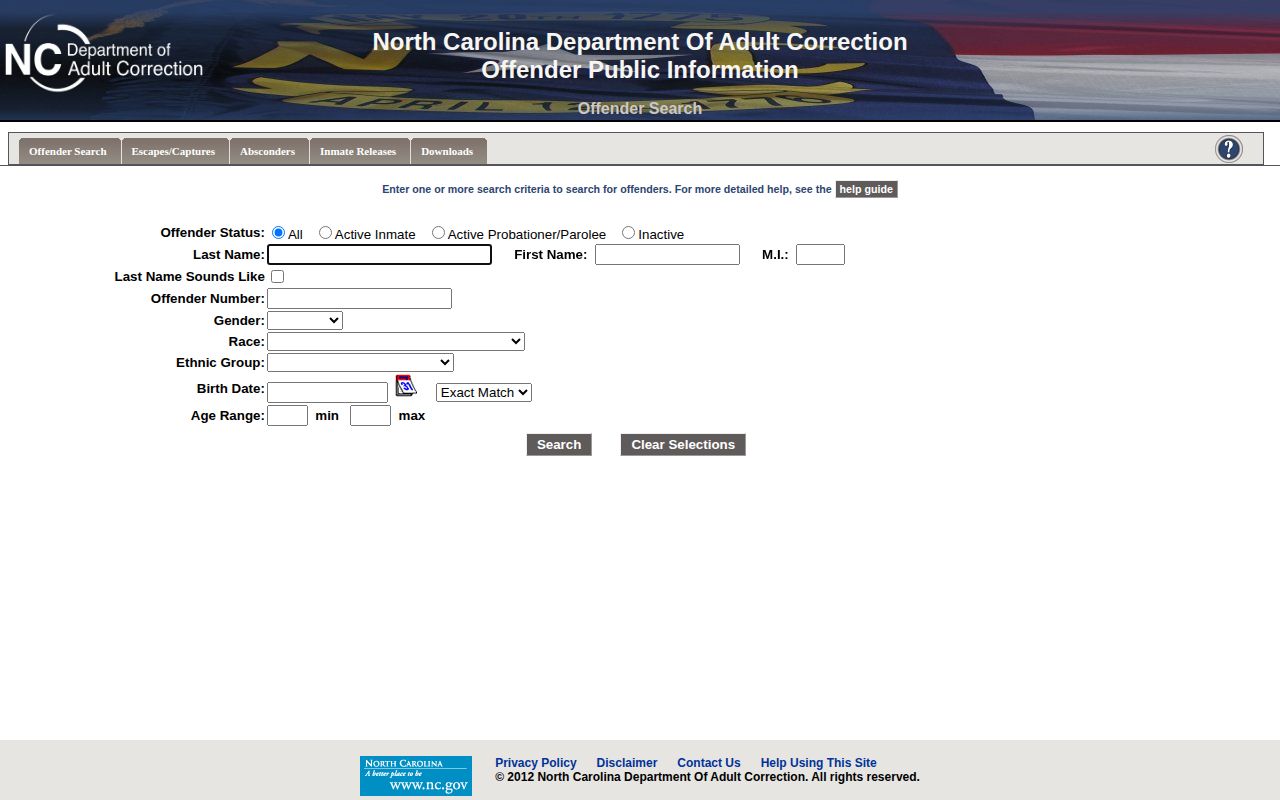
The form combines criteria and caps broad results, so a narrowly identified OPUS search is preferable. An over-restricted identity search can suppress a correct result.
Wake Detention can be reached at 919-773-7930 for Hammond Road. When an online field is absent or contradictory, a narrow Wake County records request can ask for the existing admission, custody movement, actual release date and time, release type or authority, and receiving agency or destination. The full records sequence appears on the Wake County released-inmate search.
Wake Pretrial Cases Have No Release Date
A person held before judgment does not have a sentence-based projected release date. The useful record is the Wake criminal case, where a bond order, dismissal, acquittal, plea, judgment, or other order can authorize a change. Public eCourts information and clerk terminals can reveal that legal event. Wake criminal paper files are handled at the Wake County Justice Center, 300 S. Salisbury Street in Raleigh, Monday through Friday from 8:30 a.m. to 5 p.m.
That order still does not prove the precise physical exit. Release processing can remain incomplete, and another case, warrant, or hold may control the next movement. Call the responsible Wake detention facility and ask for the custody event. If the person is no longer on the county interface, search NCDAC OPI before treating the disappearance as freedom because a transport into state prison is a transfer.
For a local sentence imposed after judgment, compare the court term, credit for time already confined, and any concurrent or consecutive structure with the Sheriff's computed event. Do not estimate from the arrest date. Booking may follow an earlier arrest, and the credit recognized in the judgment may not equal every calendar day that appears in a public timeline.
Wake Release Dates Use the Minimum
North Carolina must not be described with a copied rule that every prisoner serves 85 percent. For Structured Sentencing felonies committed on or after October 1, 1994, N.C.G.S. § 15A-1340.13(d) requires an active felon to serve the judicial minimum. Earned time may reduce the maximum but cannot shorten imprisonment below that minimum. The accurate short description is 100% of the minimum, with qualifying pretrial confinement credit and earned-time effects applied within the minimum-to-maximum sentence structure.
This rule matters for a Wake projected release date because a maximum-term calculation should not be converted into a broad percentage promise. Section 15A-1340.17 formulas may add a percentage and a supervision component to the minimum when setting a maximum. That arithmetic does not establish a statewide 80- or 85-percent release guarantee. Advanced Supervised Release has a narrow statutory 80-percent provision, but it is program-specific rather than a general rule.
The controlling minimum-service statute is shown in this official General Assembly source capture:
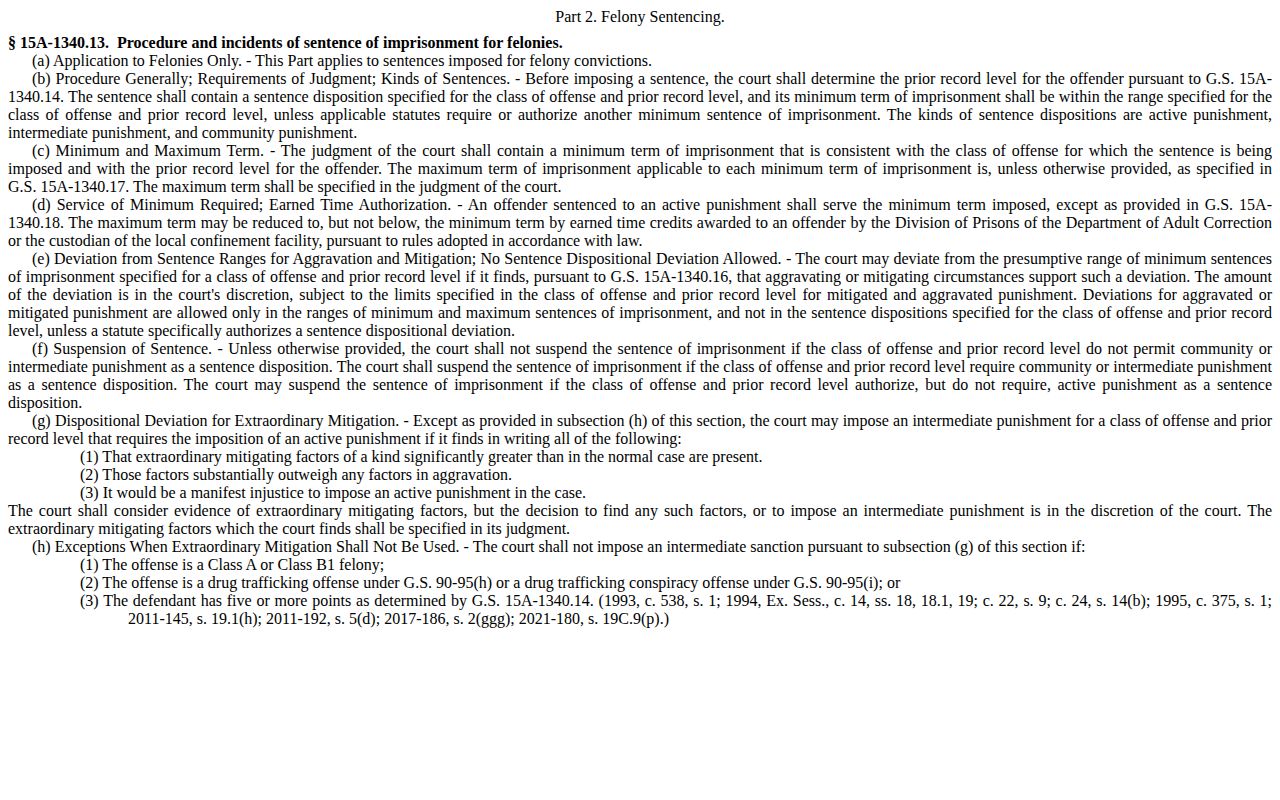
The judicial minimum, maximum, offense date, and commitment structure must be read from the actual case. A generalized percentage cannot replace those fields.
Wake County Earned-Time Release Rules
N.C.G.S. § 148-13 directs NCDAC to adopt earned-time rates and forfeiture rules. It also extends the rules to sentenced jail prisoners, so a Wake county-jail term may involve credit accounting even though it will never appear in OPI as a county jail projection. The Sheriff should be asked for the computed local event, while the judgment supplies term, jail credit, and concurrent or consecutive treatment.
For misdemeanors, § 15A-1340.20(d) limits earned-time awards to no more than four days per month. This official capture shows the misdemeanor provision:
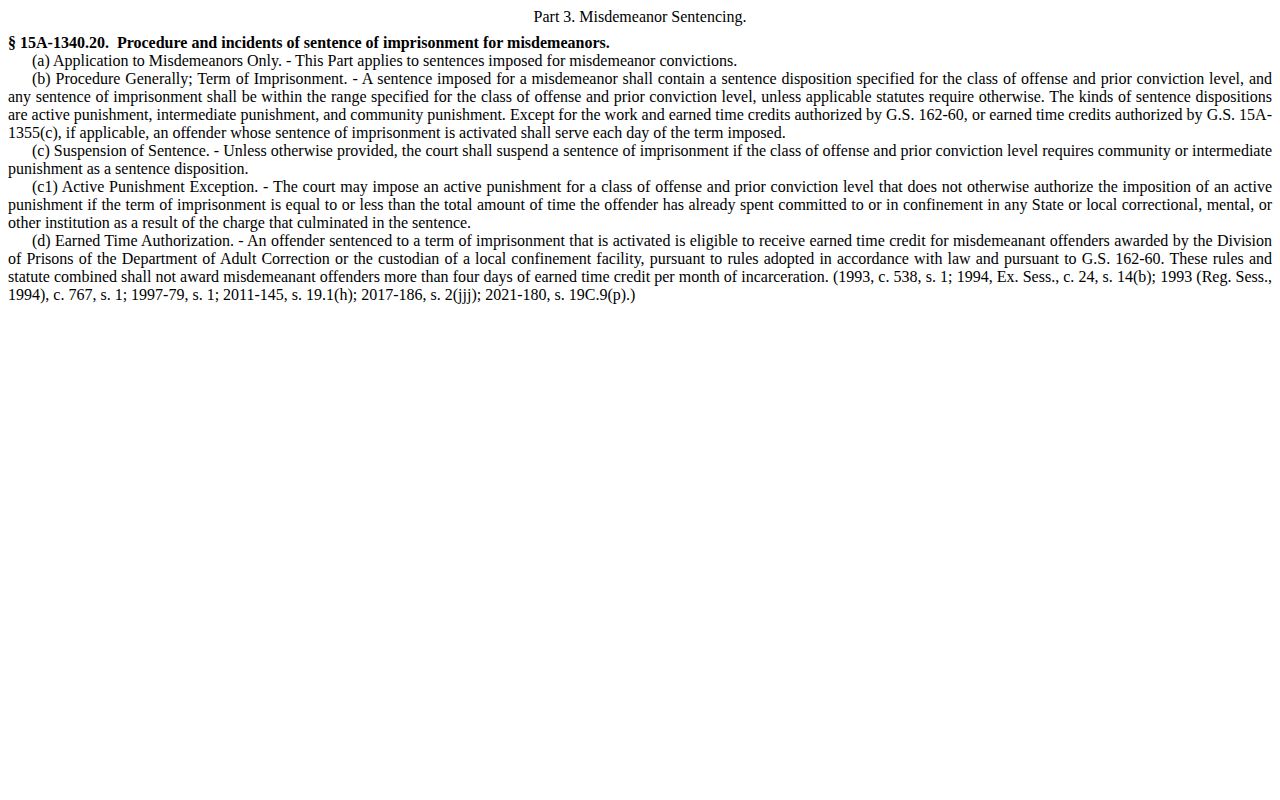
Credits are case-specific. They should not be estimated from a booking date alone, because qualifying jail credit, forfeiture, restoration, and sentence structure may not be visible in a simple public entry.
The earned-time authority is shown in the official § 148-13 text. It requires departmental rules for earning and forfeiting credit rather than granting every person the same deduction. NCDAC Victim Support also notes that projected dates can move as job and program credits change. A calculator built from the sentence maximum alone would miss these agency-maintained inputs.
For modern felonies, release from prison may begin a statutory supervision component. Under § 15A-1368.2, the release-to-supervision point is based on the maximum less 12 months for Class B1 through E felonies, less nine months for Class F through I felonies, or, in a specified reportable-conviction setting, a 60-month component, with earned-time effects. Thus the date can mark a move from prison to community supervision rather than final sentence discharge.
Note: Custody classification describes placement and security; NCDAC Victim Support states that it does not establish when a Wake County prisoner will be released.
Why Wake Release Date Calculations Change
A projected date changes when the legal or factual inputs change. The public date should be treated as current agency information, not a contractual promise. The most common research-supported factors are:
| Factor | Possible effect on the date or exit |
|---|---|
| Job or program credits | New earned time can change the maximum-term calculation within statutory limits. |
| Disciplinary forfeiture | Loss of credit can move the displayed projection later. |
| Jail-credit correction | A corrected amount of qualifying pretrial confinement can alter the computation. |
| Sentence modification | A later court order can change the term or legal basis used by the custodian. |
| Concurrent or consecutive terms | The way multiple sentences combine changes when the operative term ends. |
| Parole or supervision rules | An eligible parole decision or statutory post-release point may change confinement without ending the sentence. |
| New warrant, hold, or detainer | The sentence date may arrive, but another agency may assume custody instead of a community exit. |
Section 148-10.5 requires NCDAC to coordinate outstanding-warrant checks at intake and before release and, when feasible, seek resolution during custody. This helps explain why an uncomplicated door exit cannot be inferred from one projected date. The receiving-custodian field matters whenever a warrant or detainer controls the next movement.
Wake State-Prison Release Month Records
NCDAC provides a separate Inmate Release Search organized by county, year, and month. Selecting Wake searches state-prison releases recorded with Wake as the release county. It is not a Wake jail list, does not supply a rolling daily feed, and does not necessarily identify the county of conviction or the prison location.
The state-prison release interface is shown here:
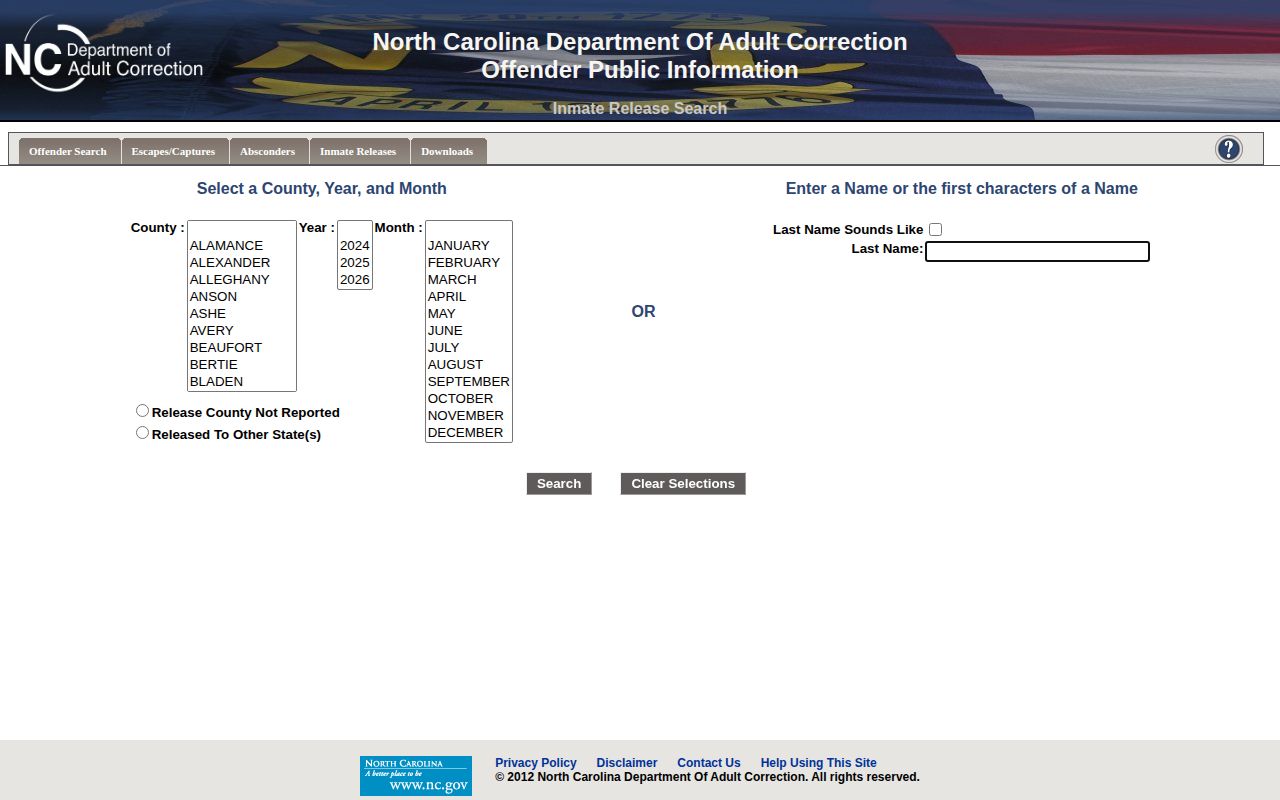
Open the individual result and compare the last movement, status, and actual date. The monthly release search is useful after the fact, while the OPI Projected Release Date is useful before the event. Neither substitutes for a Wake Sheriff's record when the person served only a local jail term.
Confirm a Wake County Release Date
Near an expected state or county release, NC SAVAN through VINELink can provide a person-specific custody-event alert. Registration does not freeze the projected date and an alert is not a certified release record. The Wake County VINELink check explains the state channels, telephone PIN process, transfer limits, and confirmation steps.
For county custody, call the Wake facility and compare the event with the court disposition. For state custody, refresh OPI and examine the last movement and current status. If the event points to federal custody, use the BOP locator for a sentenced federal prisoner; a USMS pretrial detainee may not appear there. Immigration custody requires ICE's separate locator. Absence from the Wake screen can mean transfer, data lag, expunction-related removal, or an identity mismatch, not release.
The strongest confirmation is two-part: the legal event authorizing the exit plus the custodian's completed movement showing what happened. Record the time checked, preserve the identifier, and ask the responsible office for existing public fields if the online result lacks a destination or actual date.
NCDAC's public-record guidance says basic conviction, time served, sentence length, admission, and release dates are generally public, while most detailed offender records remain confidential. After checking OPI, an electronic request can identify the OPUS number and ask for existing public admission, sentence, movement, and release fields. Medical, security, investigative, and other protected material will not be supplied. For a Wake jail case, send the corresponding narrow request to the county custodian rather than NCDAC.
Public Record Search
Sponsored Results