
Baker Center Release Outcomes
The Wake County John H. Baker Jr. Public Safety Center serves as an adult county booking, holding, and public-safety complex. People can be processed downtown even though Wake detention operations also use the larger Hammond Road facility. A bond, unsecured release, court order, dismissal, or completed local custodial term may allow a person to enter the community if no other charge or hold applies. The case may still be pending after a bond release, and release conditions can remain in force.
A departure from the Baker Center is not always a release. Transport to Hammond Road is an internal county custody movement. Transfer to NCDAC, another county, the U.S. Marshals Service, or immigration authorities also means custody continues. Ask for the destination field whenever possible. The Sheriff's record should distinguish a community exit from a handoff, while the related court file explains the order, bond, judgment, or disposition that affected local custody.
Downtown Booking and Release Flow
The downtown location can make a court appearance, booking event, and detention movement seem like one transaction. They are separate records. A magistrate or judge may set conditions. The Sheriff's Office records booking and custody movement. A clerk maintains the court file. When another agency takes control, that agency holds the later record. A sound review follows each stage rather than assuming the nearest building controls every part of the process.
Court order → Sheriff's custody check → destination → receiving custodian, if any. That short flow helps resolve most uncertainty. If the court record authorizes release but the Wake event names NCDAC, the person remained confined. If the Wake event shows a community destination but the criminal case remains pending, the person left jail without ending the case. If no clear event is available online, request the existing custody record.
| Source | What it can establish | What it cannot establish alone |
|---|---|---|
| Wake inmate inquiry | Current local booking or custody lead | Why a name disappeared |
| Sheriff release event | Time, authority, facility, and destination where recorded | Complete later court history |
| Wake criminal court file | Bond, order, disposition, judgment, or sentence | Exact physical exit time or unrelated hold |
| NCDAC offender record | State admission, status, movements, and release history | County jail booking details |
Confirm a Baker Center Release
Begin with reliable identifiers. A full name, date of birth, booking number, and Wake court file number help separate similar records. The live Wake inquiry remains only a lead because omission can reflect transfer, timing, spelling, identity matching, or an expunction-related change. A certified or custodian-supplied event is stronger than a screen that simply stopped showing a name.
- Check the current Wake inquiry for a matching local booking. Record the booking or case identifier without treating absence as release proof.
- Call the Public Safety Center at 919-856-5952. Ask whether the movement was community release, transfer to Hammond Road, or transfer to another agency.
- Use the county records portal to request the existing admission and release event, including date, time, reason, facility, and destination.
- Review the public criminal case through the North Carolina courts channel to identify the legal authority. A court disposition complements the Sheriff's event.
- If the destination was NCDAC, continue with the state offender search. For another receiving agency, confirm directly with that custodian.
The Wake County released-inmate search explains the full local, state, court, notification, federal, and records-request fallback. That wider path is useful when a downtown booking appears but no conclusive release record is visible.
Note: A missing Wake inquiry result is a reason to check the custody event, not proof that the person entered the community.
Baker Center Records and Contact
The Sheriff's Office operates the adult detention function at this downtown complex. Use its facility number for time-sensitive questions, but file a narrow county record request when a documented answer is needed. Ask for an existing record, not a new analysis. No fixed fee or guaranteed release-record turnaround was found in Wake's reviewed public material, so the custodian must state any cost and response details.
John H. Baker Jr. Public Safety Center
330 S. Salisbury Street
Raleigh, NC
Phone: 919-856-5952
The nearby Wake County Justice Center page provides official criminal-court contacts and local access details.
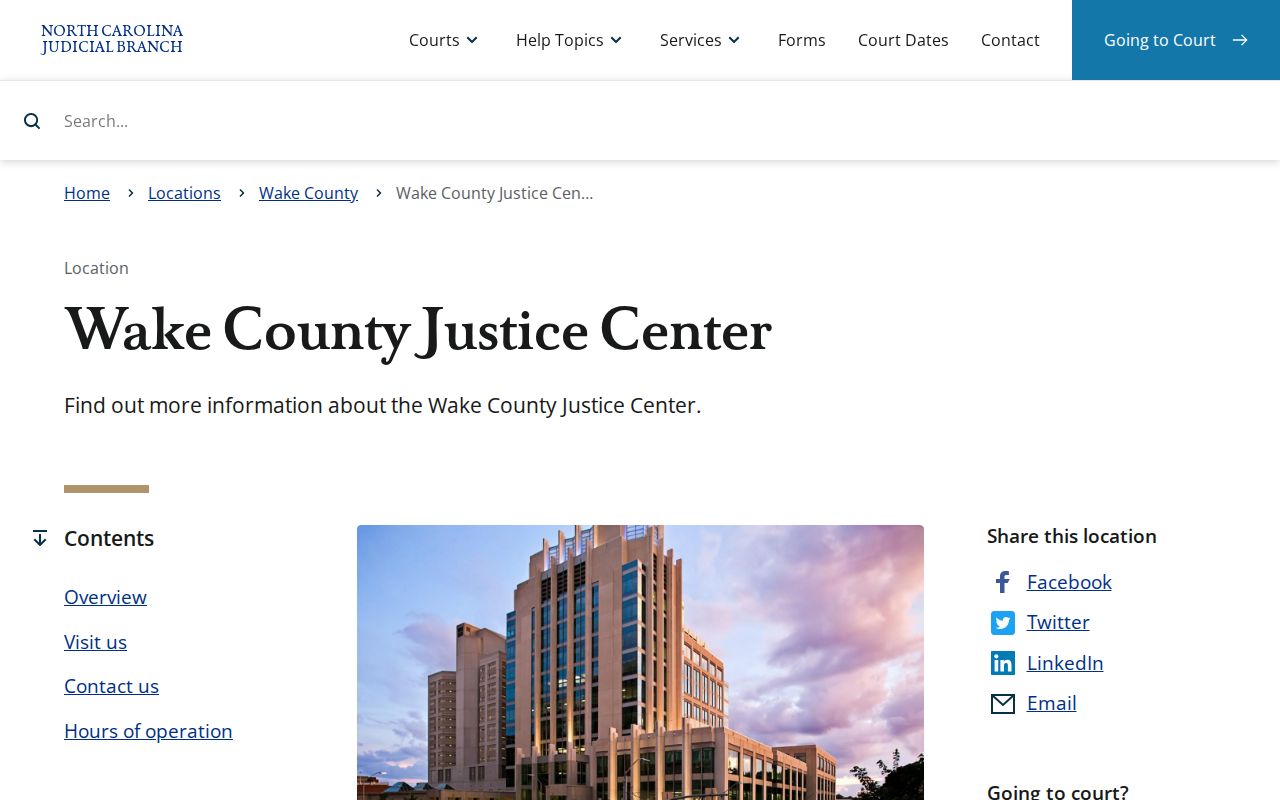
The court source is a companion to the Sheriff's custody record. It can explain an order or disposition but should not be treated as proof of the exact release movement.
Baker Release and Court Records
The Wake County Justice Center at 300 S. Salisbury Street is the local criminal-court location, adjacent to the Public Safety Center area. Its published weekday hours are 8:30 a.m. to 5 p.m. The main number is 919-792-4000, the criminal case line is 919-792-4300, and the record or expunction line is 919-792-4325. The North Carolina Judicial Branch provides online Portal access, clerk terminals, and paper files where a record is public.
Search the court file with the defendant's name and file number when possible. Useful entries can include charges, hearing dates, bond, disposition, judgment, sentence, and later orders. Under N.C.G.S. § 7A-109, court records follow a distinct inspection and copy framework. Sealed, expunged, and confidential material will not be available through ordinary public channels.
- Bond release
- Departure under bond terms while the criminal case may remain active.
- Dismissal
- A charge ends, but another charge or hold may still prevent physical release.
- Time served
- The recorded custodial component has been completed, subject to any other valid hold.
- Transfer
- Custody changes hands or locations and the person does not enter the community.
Note: The Justice Center is a strong source for legal authority, while the Sheriff's event remains the source for physical release and destination.
Baker Center Release Record Fields
A precise request is more useful than asking for “everything.” Identify the person and booking, then ask for the fields that resolve release status. Wake's custodian may redact or withhold information protected by investigatory, security, personal, sealed, or expungement rules. It is still appropriate to ask for the disclosable portion and the legal basis for any denial.
| Field | Release question answered |
|---|---|
| Booking number and admission date | Which detention episode is involved? |
| Release date and time | When did the recorded movement occur? |
| Authority or reason | Was it bond, court order, dismissal, time served, or transfer? |
| Releasing location | Did Baker Center or another Wake facility record it? |
| Destination or receiving custodian | Did county custody end or continue elsewhere? |
| Case and charge link | Which public court file explains the action? |
Wake's Bureau of Forensic Services arrest system is a different record. The official research says it covers reported Wake arrests from April 27, 2007 forward but is not guaranteed complete. Automatic expunctions can also affect visibility. A missing arrest page therefore cannot establish no arrest, no custody, or community release.
Downtown Arrest Access Change
Wake's public arrest-data access was changing at the research date. A July 2026 report stated that online mugshots and daily arrest reports were expected to stop on August 17, 2026 because automatic expunction information did not consistently reach the Bureau database. Continuously updated public arrest access was expected to shift to an in-person desk at the Public Safety Center after that date. Confirm implementation with the agency because the date and process are time-sensitive.
This policy concerns proactive online arrest publication, not a new release feed. Wake did not expose a verified rolling 24-hour or 72-hour release list in the reviewed channels. The disappearance of a booking image cannot prove release, expunction, innocence, or the absence of an arrest. For release status, request the custody event and use the court record only to explain its legal basis.
Hammond Expansion and Baker Releases
The county's current detention construction concerns the Hammond Road complex, not evidence of a new Baker Center release rule. Hammond Road developed under a 1999 master plan, with phases completed in 2005 and 2012. Planning material describes a roughly 120,000-square-foot third phase with about 448 maximum-security beds. February 2026 materials projected annex work completion in December 2026 and occupancy after a transition period in spring 2027.
Those milestones are projections and must stay separate from individual custody records. Construction can affect operations, but it does not prove that a person moved from downtown, left Wake custody, or entered the community. The combined rated capacity reported for both adult county detention locations was 1,574, split between 1,094 at Hammond Road and 480 at the Public Safety Center. Capacity is facility context, not a release count or live population figure.
Note: Use the recorded destination to confirm a Baker Center movement because county construction plans do not establish anyone's custody status.