
Wake County Parole and Probation Compared
A person can leave a Wake jail or North Carolina prison without being free of every legal obligation. The source of the authority matters. A judge imposes probation, the Post-Release Supervision and Parole Commission controls eligible parole and post-release cases, and the NCDAC Division of Community Supervision administers people in all three community categories.
| Status | How it begins | What release means |
|---|---|---|
| Probation | A court orders supervision, sometimes instead of active imprisonment or after a short custody term. | The person is in the community but the criminal case remains subject to court conditions. |
| Parole | The Commission grants conditional early release under an eligible parole-law sentence. | Prison custody ends, but the older sentence continues under supervised conditions. |
| Post-release supervision | State law supplies the community portion of a modern structured felony sentence. | Release from prison starts supervision and is not the same as final sentence discharge. |
Verify Wake County Post-Release Supervision
The NCDAC Offender Public Information Search, or OPI, covers state prisoners, probationers, and parolees, with history back to 1972. It does not cover a person whose only record is in a Wake County jail. Use an OPUS offender number when available because it is the fastest unique search path. Name, birth date, age range, race, gender, and a sounds-like option can help distinguish people, but combining too many criteria can hide the correct match.
- Select Active Probationer/Parolee when current community supervision is expected.
- Enter the OPUS number without leading zeroes, or use identity fields carefully.
- Open the matching detail and read the exact Probation/Parole/Post Release Status.
- Record the Probation/Parole Office listed on the current detail rather than choosing a Wake office by proximity.
- Repeat the search with Inactive if the active filter returns nothing, then inspect the supervision and incarceration histories.
- Confirm a current assignment or discharge with the named NCDAC unit when the public detail is unclear.
The official Community Supervision overview explains the agency that manages these statuses. This captured state page shows the correct institutional source for a Wake County supervision check:
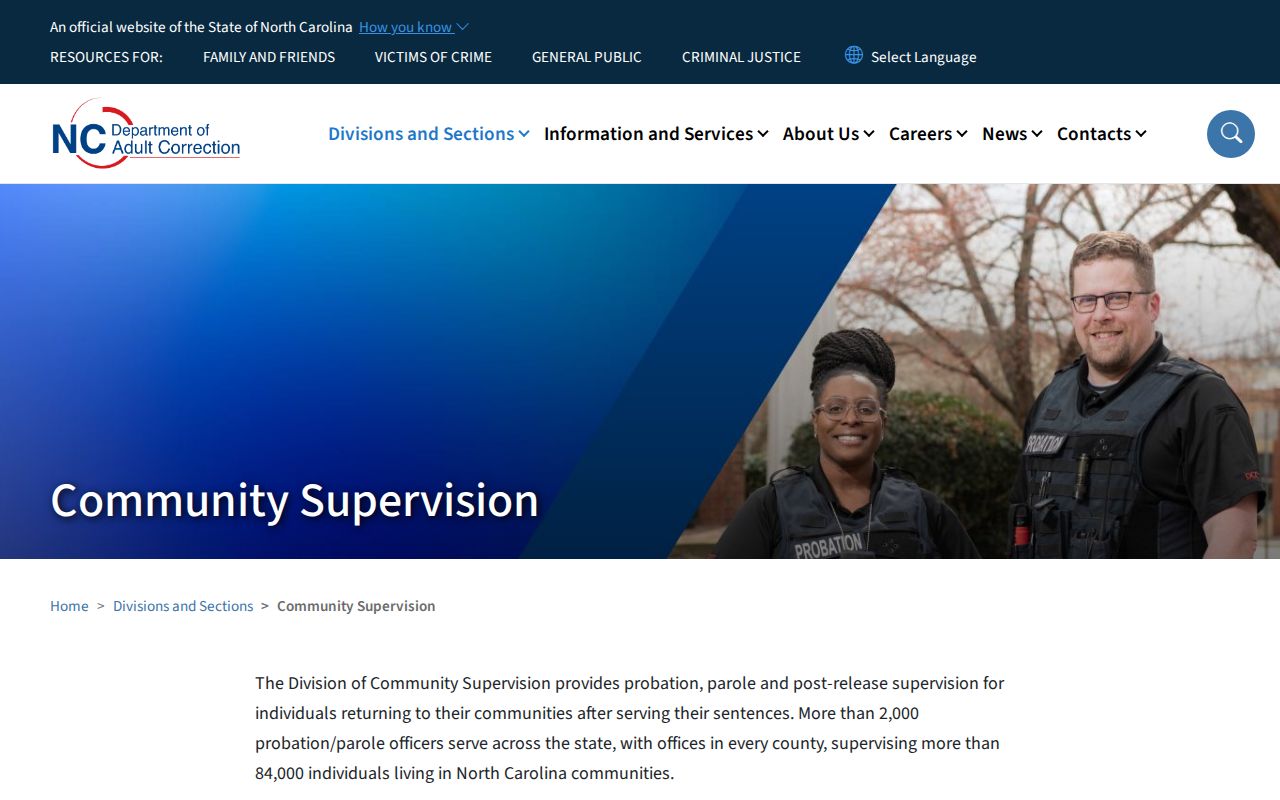
Use the person-specific OPI record after reviewing the overview. An agency description cannot confirm whether one named person is active, inactive, or discharged.
Note: An inactive OPI record means the person is not now active in the displayed inmate or supervision categories; it does not identify the last event by itself.
Find the Wake Supervision Office
Wake County has more than one supervision unit, and assignments can change. The precise Probation/Parole Office field on an active OPI record is therefore more useful than selecting an address from a general map. Match the named unit to NCDAC's local office directory, then contact that office for routing. Do not assume that the office nearest a residence owns the case.
2020 Yonkers Road
4250 Mail Service Center
Raleigh, NC 27699-4250
919-716-3100
The statewide contact can route a caller when the public record names a unit but the directory is hard to reconcile. A supervising officer may change without changing the underlying Wake County parole, probation, or post-release status.
Wake County Parole Decision Records
North Carolina parole is largely tied to offenses committed before Structured Sentencing began on October 1, 1994. Eligibility under N.C.G.S. § 15A-1371 means consideration, not a right to release. The independent four-member Post-Release Supervision and Parole Commission requires a majority decision and says it does not conduct formal hearings or meet personally with offenders during review. A conventional public hearing-room calendar therefore does not exist.
The research substitute is the Commission's monthly Discretionary Parole Reviews series. As of July 30, 2026, the hub carried monthly files from September 2024 through June 2026. The spreadsheets can include OPUS number, name, birth and demographic details, parole type, decision, denial indicators, primary offense, time served, and sentence imposed. Recorded outcomes include Approve, Deny, and Incomplete. The Commission also defines Suspend. Incomplete indicates that more information is needed, such as an evaluation or MAPP investigation; Suspend ends consideration at that time.
The Commission overview identifies the responsible body. This source capture helps separate Commission review from day-to-day probation supervision:
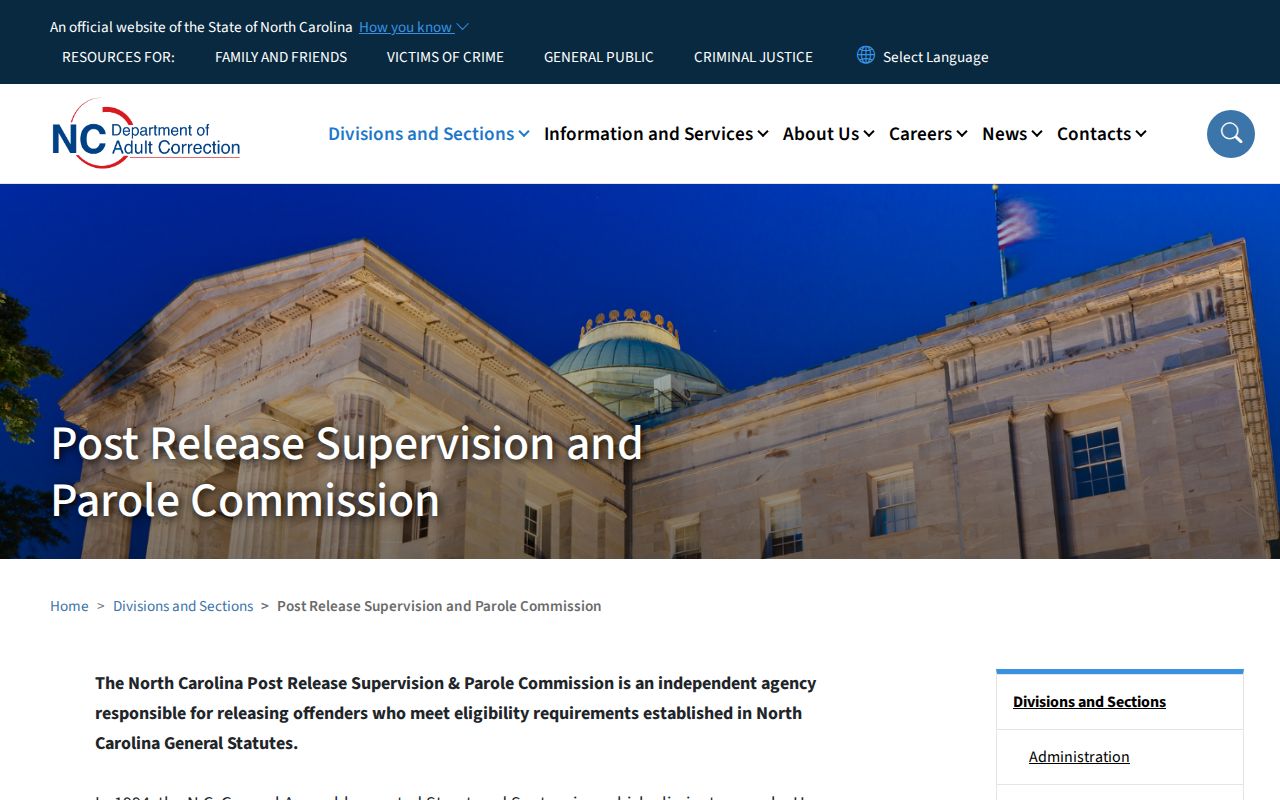
An approval is not an actual gate movement. Check the OPI last movement, current status, and date to establish whether release occurred, and use the broader Wake County released-inmate search path when county custody or another agency may also be involved.
The four statutory denial themes address the risk that a person will not follow reasonable parole conditions, whether release would diminish the seriousness of the offense or disrespect the law, whether more correctional treatment or training would help, and the risk of further crime. Those are Commission decision factors, not new convictions. Other Commission records remain confidential even though the agency voluntarily publishes selected monthly data.
A defined 90-day mandatory-parole cohort is governed by § 15A-1380.2 for qualifying felony terms of 18 months or more tied to offenses from July 1, 1981 through September 30, 1994. Special probation and certain health-law sentences are excluded from the broader eligibility rule, while an exception exists for eligible juveniles sentenced to life with parole. These offense-date and sentence details explain why a Wake County record should be matched by OPUS number before interpreting a decision row.
Wake County Absconder Records Need Context
NCDAC defines an absconder as a supervised person who fails to maintain contact with an officer and actively avoids supervision so that the person's location becomes unknown. The official absconder search accepts a last name and county of supervision, including Wake. That county filter reflects the supervision case, not proof of a present physical location.
The Wake-filtered screen is shown in this official source capture:
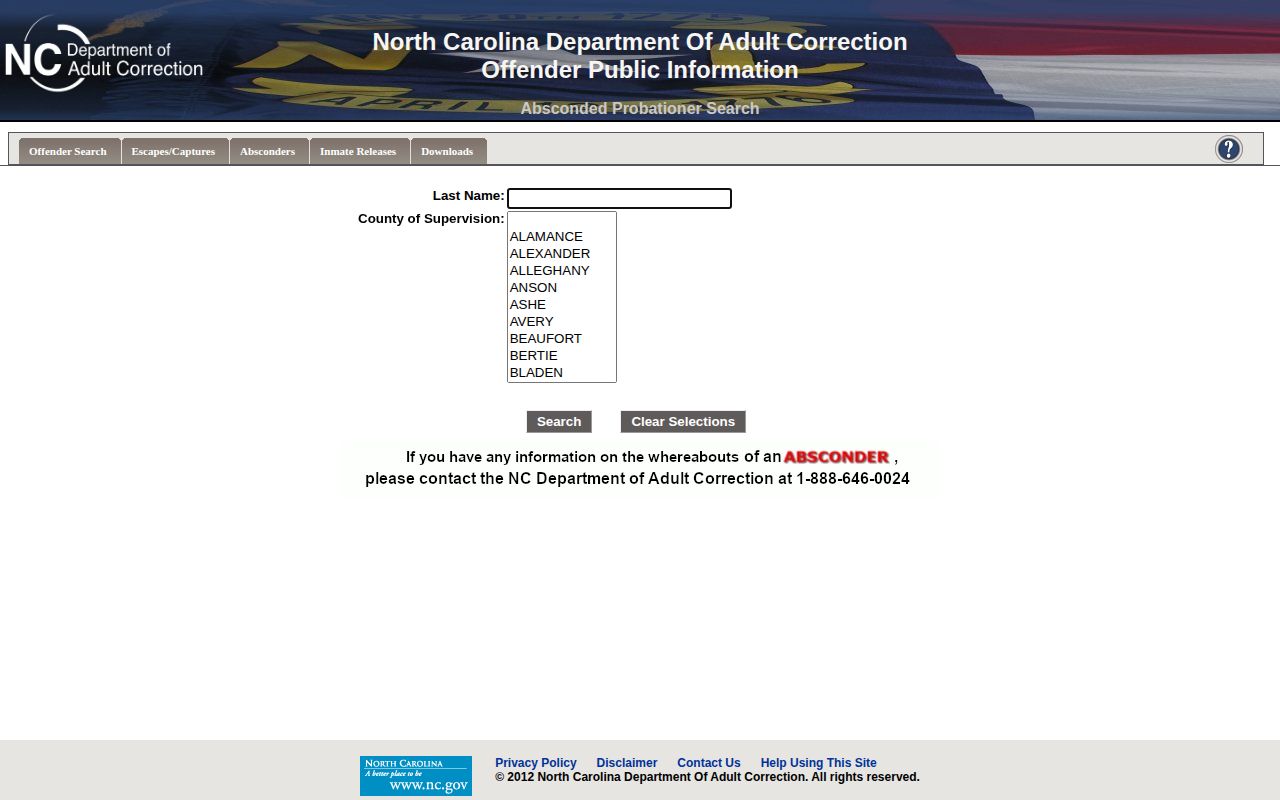
NCDAC cautions that a listed person may actually be incarcerated elsewhere, outside the United States, or deceased while record removal is pending. For that reason, a result is not proof of a live Wake warrant and is not proof that the person is locally at large. Possible supervision consequences can include extension, revocation, or return to prison in parole and post-release matters. Anonymous tips may be directed to 888-646-0024; immediate danger belongs with 911.
Wake Supervision Conditions and Discharge
Conditions depend on the judgment, release authority, and individual case. A violation does not prove that someone is already back in custody. The supervising officer, court, or Commission determines the next procedural step, while OPI may later reflect a status or movement change. NC SAVAN through VINELink can provide custody-event notifications for county jail inmates, state prisoners, probationers, and parolees, but an alert remains a lead that should be checked with the contributing agency.
Post-release supervision illustrates why the words release and discharge should not be interchanged. Under § 15A-1368.2, supervision ordinarily begins at the maximum term less 12 months for Class B1 through E felonies or less nine months for Class F through I felonies, with earned-time effects. Certain reportable-conviction maximums use a 60-month component. Usual supervision periods are 12 months, nine months, or five years for covered registration offenses. Completion terminates the sentence.
Probation discharge is established through the court and supervision record. Parole or post-release discharge is established through NCDAC and Commission records. If an online status conflicts with a recent notice, ask for the existing public supervision, movement, release, or discharge fields by OPUS number rather than drawing a conclusion from a missing result.
NCDAC says most detailed offender material is confidential, but basic conviction information, time served, sentence length, admission, and release dates are public. Check OPI first, then use the department's electronic public-record request form for existing public fields that the web detail does not resolve. A narrowly framed request should name the OPUS number, status in dispute, relevant dates, and specific movement or supervision field. Medical, security, investigative, and other protected details will not be supplied.
Wake County Reentry Is Not Release
Wake Correctional Center and the North Carolina Correctional Institution for Women are designated reentry facilities, and NCDAC publishes a Wake County reentry resource page. Wake Correctional Center also supports work release. Those facts describe preparation and custody programming, not a public release or sentence discharge. A participant may be physically present in the community for authorized work while still in NCDAC custody.
The Wake Local Reentry Council appears in NCDAC's local-council network and can help with resource navigation after release. It does not confirm custody status, supervision, or a release date. A separate NCDAC and DMV identification program can prepare optional identification for qualifying state prisoners close to release, subject to its eligibility rules, but it does not automatically cover a Wake jail release.
For any person moving through this local reentry cluster, read the OPI current status and last movement together. Active Inmate indicates state prison custody; Active Probationer/Parolee identifies community supervision; Inactive requires review of the histories. That record distinction prevents work release, reentry placement, or transfer from being mistaken for final discharge.
Public Record Search
Sponsored Results