
Wake County Release Records
A Wake County release record is a custody-event record. It identifies that a person left a Sheriff's facility and may state when, why, under whose authority, and to what destination. That last field matters. Someone who posts bond or completes a local sentence may return to the community. Someone transported from the John H. Baker Jr. Public Safety Center to Hammond Road, NCDAC, another county, the U.S. Marshals Service, or ICE remains in custody.
Absence from the Wake arrest interface is only a lead. The record may have changed after an expunction, the person's name may differ, data may lag, or the person may have transferred. A sound finding pairs the legal event, such as a bond order or judgment, with the Sheriff's physical release or transfer event.
- Discharge
- The end of the custodial or supervision status recorded by the responsible agency.
- Time served
- Completion of the jail term credited by the releasing authority.
- Detainer
- A request or authority that can move a person to another custodian instead of the community.
- Post-release supervision
- The required community portion of some North Carolina prison sentences.
How Wake Inmates Leave Custody
The wording on the event determines the next verification step. Release does not erase the charge, establish innocence, or end every court obligation. It describes a change in custody.
| Event | Meaning | Confirm next |
|---|---|---|
| Bond or written promise | Community exit while the case continues | Sheriff event and eCourts order |
| Time served or sentence complete | Recorded local custodial term ended | Jail event and judgment |
| Dismissal or court order | Legal authority may permit exit if no hold remains | Order plus physical release event |
| NCDAC transfer | State incarceration began or continued | NCDAC Offender Public Information |
| USMS or ICE transfer | Federal custody may continue | Federal court, USMS, BOP, or ICE channel |
| Parole or post-release supervision | Prison custody changed to supervised community status | NCDAC status and supervision unit |
Fields in Wake Release Records
A focused request should name the existing booking or release records and the fields needed. Broad requests can make identity matching harder and may seek information the custodian does not keep in one document.
| Field | What it establishes |
|---|---|
| Name, alias, date of birth | Which person the record concerns |
| Booking or CCBI number | The local custody episode |
| Admission and release date/time | The recorded custody interval |
| Releasing facility | Which Wake location recorded the exit |
| Release authority or reason | Bond, court order, completion, or other legal basis |
| Destination or receiving agency | Community exit versus continued custody |
| Charge, bond, and case link | The associated criminal matter |
| Supervision to follow | Possible probation, parole, or post-release status |
Juvenile, expunged, sealed, investigative, security, medical, and personal information can be withheld or redacted. The agency need not create a custom report that does not already exist.
Request Wake County Release Records
Wake County accepts public-record requests through its NextRequest portal. Address the request to the Sheriff's Office or correct custodian, ask for electronic delivery, and describe a narrow date range.
- Give the full name, known aliases, date of birth, booking or CCBI number, facility, and case number when available.
- Request the existing booking/release sheet or custody-event log, including actual release time, authority, type, and receiving destination.
- Ask separately for a retained booking photograph if it remains public and disclosable.
- Review the response against the court disposition and follow up on a transfer with the receiving custodian.
A certified Bureau arrest search is a different product. It costs $15 per name and is stated to mail in one to two business days after receipt. Official sources conflict on the Bureau mailing ZIP, so verify it at 919-856-6300 before sending payment. Wake publishes no fixed fee or guaranteed turnaround for an ordinary release record or booking-photo request.
Wake Release Access and Expunction
North Carolina Chapter 132 starts with broad public access to government records, including photographs and electronic records. Exceptions govern criminal-investigation material, security data, personal identifiers, juvenile matters, correctional files, and expunged or sealed cases. Court records also operate under separate authority, including section 7A-109.
Wake's arrest interface is not a permanent release archive. Wake planned to stop online mugshot and daily-arrest publication on August 17, 2026, with continuously updated arrest access expected at the Public Safety Center desk. Its official warning says the data is not guaranteed complete and may miss automatic expunction updates. This arrest access is not a 24-hour or 72-hour release feed.
No universal public-display period or release-record retention period was verified for Wake. Inspection rights, agency retention, and proactive web publication are separate questions. A missing online entry proves none of them by itself.
An expunction removes qualifying material under a court-controlled legal process. It should not be inferred from a blank search, and an old cached copy should not be republished as though it were current. When an official result and an older copy conflict, the clerk and the agency custodian are the proper sources for the current public status.
Wake Booking Data Is Not People
A county and SAS study of Sheriff's records reviewed data from July 2013 through December 2016. It counted 61,365 distinct people but 272,592 bookings, along with length of stay, charges, bond status, and general release information. Those are dated study figures, not current release totals.
The gap illustrates an important records point: one person can have more than one booking. Search results should be tied to a booking number and case rather than treated as a count of unique people. The underlying Sheriff's data may also carry release details that the public arrest screen does not display.
Find Released Wake County Inmates
Use the original custodian and the expected next destination to choose a search. Checking every system without following the custody path can produce false matches.
- Collect the full name, birth date, approximate booking period, and known booking, OPUS, register, or case number.
- Check the Wake inquiry only for a current local lead. If the person is absent, call Detention at 919-773-7930 or request the release event.
- Inspect the North Carolina eCourts Portal for the disposition, judgment, bond, or transfer order.
- Use NCDAC OPI for a state sentence or community-supervision record, then use the separate Inmate Release Search by Wake and month when appropriate.
- Use NC SAVAN for notifications, BOP for a federal prison sentence, and ICE ODLS for immigration detention within its scope.
- Resolve conflicts with the record custodian and the Wake County Justice Center paper file.
A name disappearing from the Wake jail screen does not prove community release. Transfer, expunction, data lag, and identity mismatch remain possible.
A current roster and a historical record answer opposite questions. The live Wake inquiry is most useful while a person is locally booked. A Sheriff's release sheet preserves the actual county exit. OPI becomes relevant only when state incarceration or supervision is part of the path. Court records explain authority, while NC SAVAN supplies event alerts. No single blank result replaces this chain.
Wake State Release Offender Search
The NCDAC Offender Public Information Search covers state prisoners, probationers, parolees, and historical records back to 1972. It expressly excludes county-jail data. Search by offender number when possible because that is the fastest unique route.
| Field | Use |
|---|---|
| Status | All, Active Inmate, Active Probationer/Parolee, or Inactive |
| Name | Last, first, middle initial, and sounds-like option |
| Offender number | Unique OPUS route without leading zeroes |
| Identity filters | Gender, race, ethnic group, and birth date |
| Age range | Exact or minimum/maximum narrowing |
Read the incarceration and sentence histories, last movement, actual release date, and current supervision status. “Inactive” alone does not explain the last event.
The official NCDAC criminal offender searches gateway shows the routes available for North Carolina released-person checks.
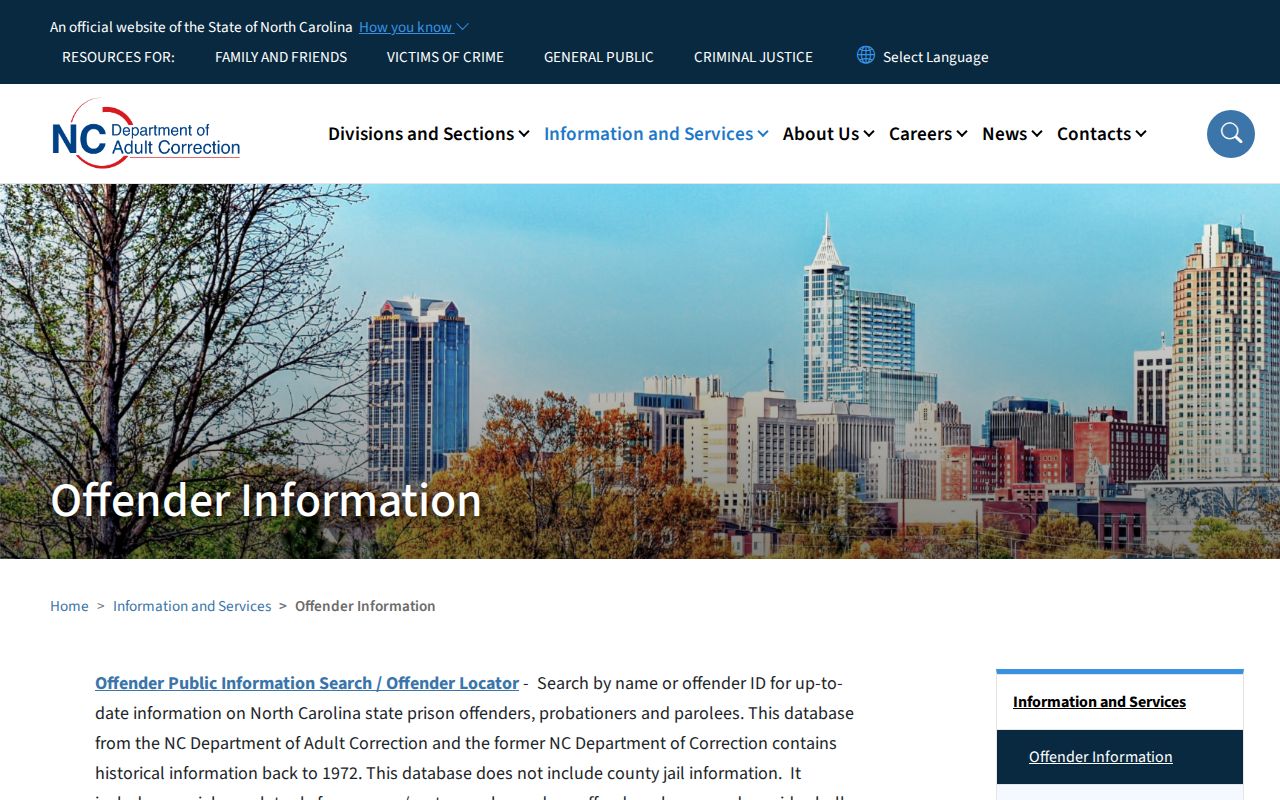
This gateway separates general OPI history, inmate releases, absconders, NC SAVAN, and registry functions that answer different questions.
NCDAC's separate Inmate Release Search works by release county, year, and month. Selecting Wake does not mean the person was held in a Wake jail or convicted in Wake County. It identifies the release-destination county recorded by NCDAC. Open the individual OPI detail and compare the last movement and current status before treating the result as a community release.
An Active Inmate status means state prison custody continues. Active Probationer/Parolee describes community supervision rather than incarceration. An Inactive status needs the underlying histories because sentence termination, death, or another data circumstance may produce that label. The exact “Projected Release Date” field, when shown, is a forecast and not an actual exit record.
Wake Release Alerts Through NC SAVAN
NC SAVAN's direct person search, delivered through VINELink, includes participating county-jail inmates, state prisoners, probationers, parolees, and registered sex offenders. It can send phone, email, text, or TTY notices for events offered on a person's record. It does not cover federal BOP or USMS custody.
Search by a precise name or identifier, open the correct contributing-agency record, and register for the available event. Telephone registration can require a four-digit PIN; other methods use their live confirmation flow. A transfer notice is not a community-release notice. The official FAQ also warns that some magistrate-level bond-outs and arraignment releases may not create a SAVAN custody event.
Notifications can lag the source record. Critical release, escape, and capture calls may arrive at any hour, while ordinary calls generally operate from 8 a.m. to 8 p.m. Confirm the event with Wake Detention or NCDAC before arranging pickup or relying on the status.
Wake Release Orders and Court Files
Wake criminal records are centered at the Wake County Justice Center, 300 South Salisbury Street. The nearby county courthouse handles civil matters, so going to the right building matters. North Carolina court-record access instructions describe the online Portal, clerk terminals, and paper files.
A judgment or bond order can explain why release was legally authorized. It does not establish the time someone walked out or rule out another hold. Pair the court result with the Sheriff's custody event.
The court-record access page illustrates the official routes available for a Wake release disposition.
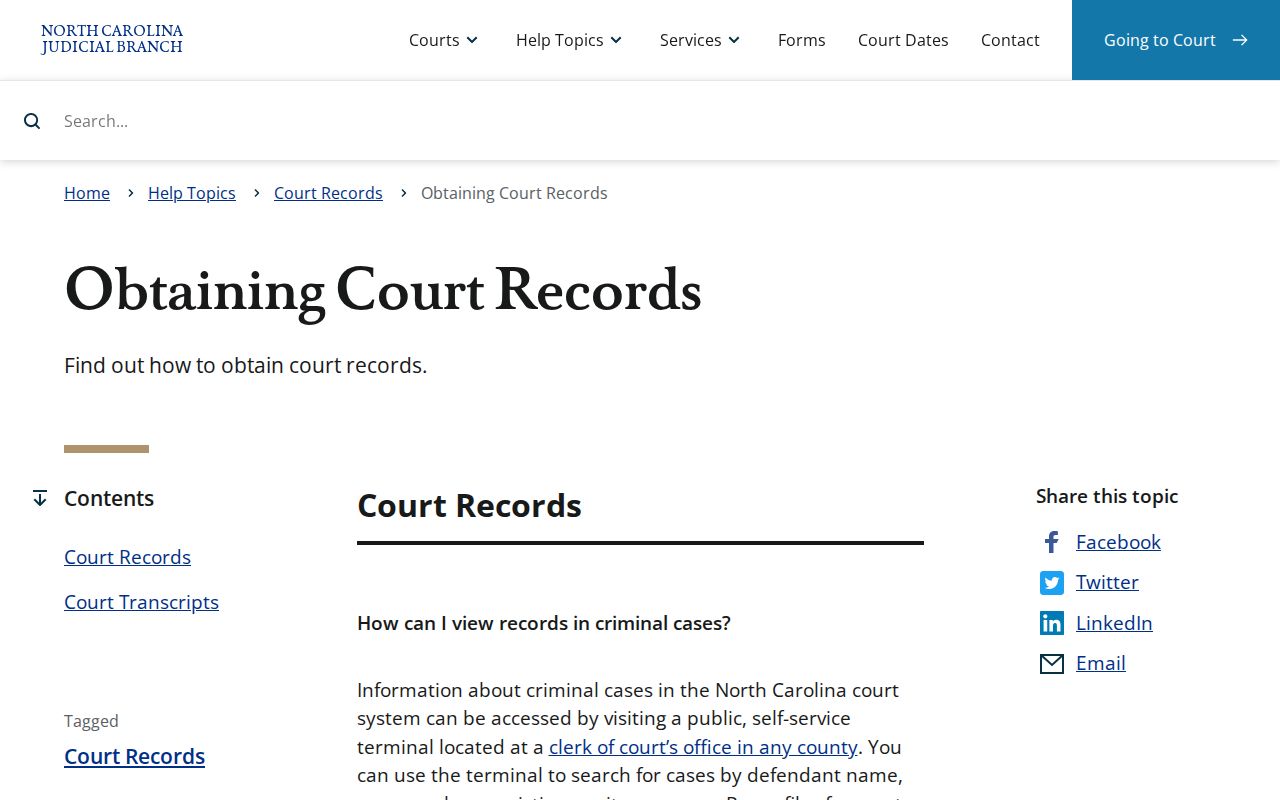
Clerk records remain useful after a brief jail-screen entry disappears, subject to juvenile, sealed, and expunged-record limits.
Wake Pretrial Release Is Distinct
ReEntry, Inc. administers Wake pretrial monitoring ordered by the court, including electronic, GPS, or continuous-alcohol monitoring. A judge can allow a person to leave jail under those conditions while the criminal case remains open.
That status is not probation, parole, post-release supervision, a dismissal, or sentence completion. The Sheriff's event and the court order establish the exit and its conditions; the program is a navigation source for its own monitoring role.
Getting Home After Wake Release
GoRaleigh service reaches the broader Hammond and Chapanoke area near the Wake County Detention Center. Wake Tech identifies Route 40X and Route 7 connections in that area. This is public transit, not a ride furnished by the jail.
Before relying on transit, check the current stop, walking route, accessibility, fare, and service time. No official Wake jail source states a fixed release exit, waiting point, or release hour. Families should confirm the actual facility and release event before traveling.
Wake Release Supervision and Reentry
Wake Correctional Center and the North Carolina Correctional Institution for Women are designated NCDAC reentry facilities. NCDAC also publishes Wake County reentry resources. These services help with practical transition needs but do not prove custody status.
Wake Correctional Center supports work release. That remains incarceration even when someone is present at an approved workplace in the community. OPI movement and status fields distinguish work release, prison transfer, release to supervision, and discharge. The Wake parole and probation page explains how to verify a named supervision unit.
North Carolina Discharge Cash Rule
Section 148-13(a) provides at least $45 in discharge or parole cash for a state prisoner incarcerated for two years or longer. It is a narrow state-prison rule. It is not a Wake County jail gate-money promise and not a fee collected from the person at release.
County and state custody must stay separate when planning for release. A Wake jail detainee should not expect a state-prison allowance based on this statute.
Wake Federal and Immigration Releases
The BOP Inmate Locator covers federal prison sentences and generally includes people released after 1982. A past release date with no facility, or a “RELEASED” location, means the person is no longer in BOP custody on that date. It does not rule out federal supervised release or custody held by USMS, a state, a county, or ICE.
ICE ODLS covers current detention and people released from ICE custody within the previous 60 days, subject to exclusions and lag. No official evidence showed a current Wake ICE detention contract or 287(g) arrangement, so a local jail departure must not be labeled an ICE release without a receiving record. USMS has no comprehensive public pretrial locator.
BOP searches accept a register, DCDC, FBI, or INS number, as well as name and demographic fields. “UNKNOWN” means the federal confinement term is undetermined, not that release occurred. First Step Act recalculations can also affect a displayed future date. For older pre-1982 federal records, the National Archives may be the proper route.
ICE ODLS requires a full name with A-number or birth date and country of origin. People under 18 and some protected cases do not display, and recent changes can take time to appear. After the 60-day released-person window closes, disappearance says nothing about current community status.
Wake County Release Facilities
Wake's two adult county locations share one local detention system. Three Raleigh state prisons require the statewide NCDAC route. The juvenile center follows confidential juvenile channels.
| Facility | Correct release route |
|---|---|
| Wake County Detention Center | Sheriff release event and court case |
| Wake County John H. Baker Jr. Public Safety Center | County booking/release record; do not confuse transfer to Hammond Road |
| Wake Correctional Center | NCDAC movement, release, and supervision status |
| Central Prison | NCDAC OPI because diagnostic and medical transfers are common |
| North Carolina Correctional Institution for Women | NCDAC OPI and Inmate Release Search |
| Wake Juvenile Detention Center | Authorized Juvenile Justice, lawyer, or juvenile-court contact |
Facility type controls both the record and the meaning of movement. A Wake adult jail event belongs to the Sheriff. A movement among NCDAC institutions stays within state custody. Juvenile detention is governed by confidential channels and cannot be checked by putting a child's name into an adult locator. The receiving agency must confirm any transfer that follows a Wake departure.
Wake Jail Expansion and Releases
The Hammond Road jail was phased under a 1999 master plan, with portions completed in 2005 and 2012. Current planning describes a roughly 120,000-square-foot third phase with 448 maximum-security beds. February 2026 materials projected later construction and occupancy milestones.
Those dates are projections. Capacity work does not itself change the inmate roster, prove a release, or establish a new release policy. Continue to use the Sheriff's event for a county exit.